
Ocean County Release Date Meanings
A projected date is a calculation based on the sentence and credits known at that point. NJDOC calls its outer calculated date the Current Max Release Date. A parole eligibility date answers a different question: when the person may be considered under parole rules. A scheduled parole date may follow a grant. The historical field, Date Out-of-Custody, records that the displayed NJDOC custody episode ended.
Ocean County Jail has its own path. A pretrial detainee does not have a sentence-based release date. A judge may order release, but OCDC booking staff still review the full commitment file to ensure every matter is legally discharged. An outside warrant, detainer, or transfer order can keep the person in custody or move the person to another agency. A county Release Date marks the end of the Ocean County episode, not always freedom from all custody.
Find Ocean County Inmate Release Dates
Start by locating the custody system. The county lookup is the correct first stop for a person held only at Ocean County Jail. The statewide NJDOC offender search is for a person transported into state custody. County of Commitment in an NJDOC record identifies the venue of conviction and sentence. It does not mean the state prisoner is housed in Ocean County.
- Search the Ocean County Inmate Lookup Tool and select “Include released inmates” when checking a county booking.
- Match the name, date of birth, Booking Number, or Permanent ID and inspect the Release Date column.
- For state custody, open the NJDOC offender search and accept its official notice.
- Match the person with the SBI number, date of birth, descriptors, aliases, and case details.
- Read Current Max Release Date, Current Parole Eligibility Date, and Date Out-of-Custody as separate fields.
- Check the judgment and sentence calculation, then confirm an actual release with the custodial agency.
When the county result is blank or missing, call the Ocean County Department of Corrections at 732-929-2043. Ask whether the identified booking remains in county custody and whether a recorded end date reflects community release or transfer. For a durable county answer, request the existing discharge or commitment-release record. The broader Ocean County release search explains the court and receiving-agency fallbacks.
Three NJDOC Release Date Fields
Ocean County state sentences are tracked through NJDOC even when the person is housed elsewhere in New Jersey. Its official definitions prevent the most common date error. The maximum date is projected, parole eligibility is prospective, and Date Out-of-Custody is historical. A searcher should preserve the field label with the date rather than copying the number alone.
| NJDOC field | What it answers | What it does not prove |
|---|---|---|
| Current Max Release Date | The latest calculated maximum release after credited and added days. | That release has occurred or the date cannot change. |
| Current Parole Eligibility Date | The expected eligibility date under NJSPB calculation policies. | That parole was granted or departure is scheduled. |
| Scheduled parole release | A future release set after an appropriate parole action. | That rescission or another hold cannot intervene. |
| Date Out-of-Custody | The date the displayed NJDOC custody episode ended. | That no supervision or other jurisdiction followed. |
The official NJDOC field definitions explain these distinctions. The manifest image below shows the state source used to interpret projected and out-of-custody data.
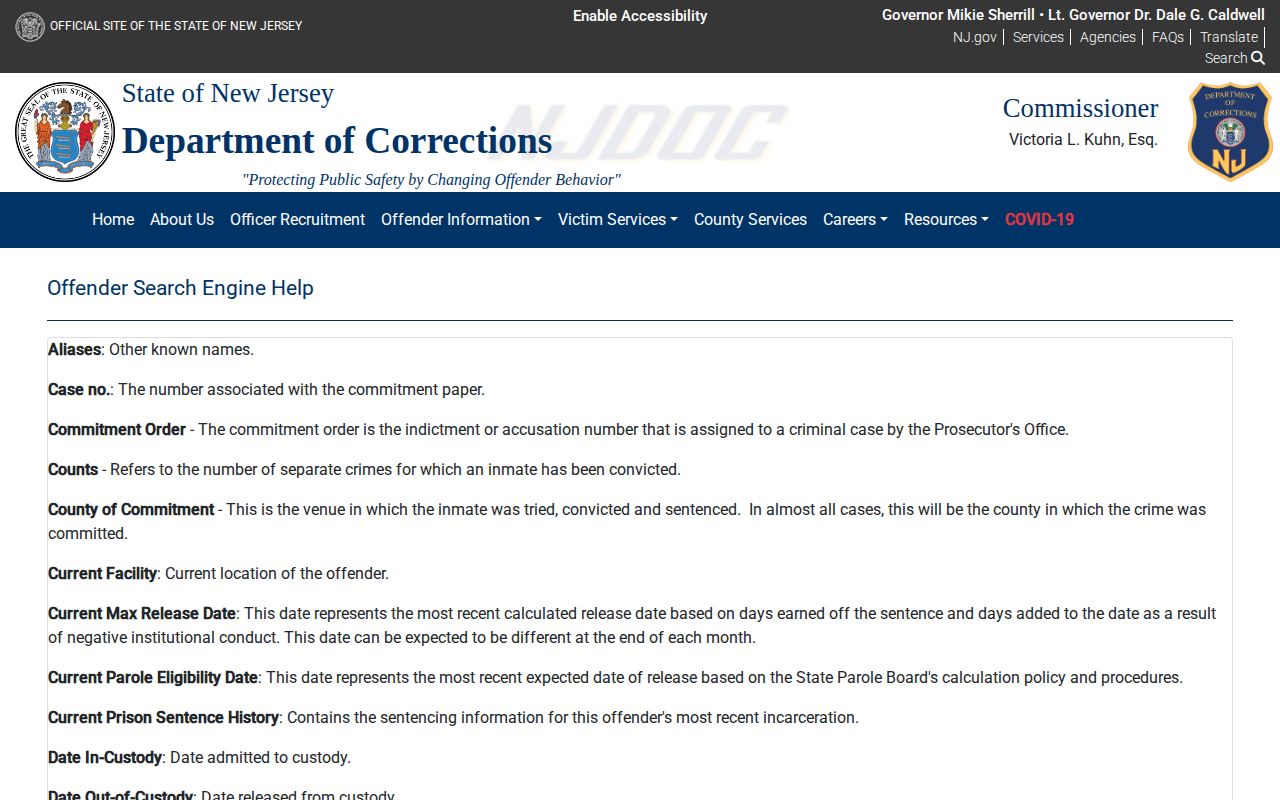
This source is more reliable than a loose “tentative release” label because it names the exact field and warns that the maximum calculation can move.
Note: Save the date viewed with a projected result so a later monthly change can be compared to the earlier calculation.
New Jersey Release Date Credits
Sentence credits can affect a projected date, but they do not all work the same way. Jail credit is awarded by the court for presentence confinement. Commutation credit, often called good credit, is applied under N.J.S.A. 30:4-140 according to its statutory schedule. The NJSPB guide cautions against describing it as newly earned one day at a time.
Work credit under N.J.S.A. 30:4-92 is one day for each five days worked. Minimum-custody credit is three days per month in the first year of minimum custody and five days per month after that. For an ordinary sentence without a mandatory minimum, primary parole eligibility is generally one-third of the sentence, reduced by the credits that legally apply. N.J.S.A. 30:4-123.51 governs that framework.
A mandatory minimum changes the analysis. Ordinary commutation, work, and minimum-custody credits do not reduce a judicial or statutory minimum. Court-awarded credits are applied under the judgment and governing rules. Concurrent or consecutive terms, later sentencing orders, and the aggregation of terms make a simple public calculator unsafe. The judgment and official sentence computation control.
Note: Credits can shape a calculation, but only NJDOC and the court record can establish the controlling sentence details.
Ocean County NERA Release Dates
The No Early Release Act, N.J.S.A. 2C:43-7.2, requires an 85-percent period without parole eligibility for enumerated first- and second-degree offenses. For that calculation, the statute treats a life term as 75 years. NERA also supplies a period of parole supervision after release where the statute applies.
It is wrong to say that all New Jersey prisoners serve 85 percent. NERA is tied to specified offenses and degrees. Other mandatory-minimum laws can produce a different result. The Ocean County judgment identifies the offense, sentence, minimum term, and jail credit that form the legal starting point. The NJDOC calculation then applies the terms within the correctional record.
- Mandatory minimum
- A part of the sentence that ordinary institutional credits cannot reduce.
- Parole eligibility
- The point when parole consideration may occur, not an actual release date.
- Commutation credit
- A statutory credit applied under New Jersey's scheduled rules.
- Jail credit
- Court-awarded credit for qualifying presentence confinement.
Why Ocean County Release Dates Change
NJDOC warns that Current Max Release Date can differ at the end of each month. Credits may be added to the calculation, while negative institutional conduct can add days or lead to loss of credit. The date can also shift for reasons outside the routine monthly update.
| Factor | Possible effect | Best confirmation |
|---|---|---|
| Credit calculation or restoration | Moves the calculated maximum date under applicable rules. | NJDOC sentence calculation. |
| Institutional conduct | May add days or cause loss of credit. | NJDOC calculation and disciplinary record where available. |
| Amended judgment or new sentence | Changes the terms or aggregation used in the computation. | Ocean County court judgment and NJDOC record. |
| Detainer or warrant | May lead to another agency's custody after the first episode ends. | Discharge record and receiving-agency record. |
| Parole denial or FET | Delays renewed consideration rather than setting a release date. | NJSPB action and eligibility calculation. |
| Parole grant rescission | Can stop a scheduled release before departure. | NJSPB final action and NJDOC custody history. |
A Future Eligibility Term, or FET, is the interval until renewed parole consideration after a denial. It is not a release date. Likewise, a parole grant can be reviewed if new information or an institutional infraction appears before release. The actual Date Out-of-Custody remains the point that closes the NJDOC custody episode.
Note: Compare each Ocean County date with its field label; eligibility, a calculated maximum, and actual release answer different questions.
Ocean County Jail Release Timing
A county jail sentence and a state-prison sentence are not interchangeable. N.J.S.A. 30:4-123.51(g) addresses primary parole eligibility for a county jail, workhouse, or penitentiary sentence by reference to the greater of 60 days of the aggregate sentence or the subsection calculation. That rule still does not let an outside reader calculate a binding personal release date.
Pretrial custody is different again. A release order can depend on the court's risk-based conditions rather than sentence credits. OCDC then clears every commitment in its file. If another matter remains, the physical departure may not occur when the first order is entered. The county publishes no routine release hour, weekend practice, or public exit point, so those details must be confirmed directly instead of inferred.
A populated Release Date in the Ocean lookup is stronger evidence than a missing roster result. Yet the destination matters. OCDC documents outside-agency pickup and transport to NJDOC. Ask for the recorded disposition or receiving agency when the question is whether the person returned to the community.
Ocean County Parole Release Dates
The New Jersey State Parole Board publishes weekly parole-eligibility notices, including an Ocean report. Each notice identifies a future period in which listed people may be released if approved. It may show a publication date, name and SPB identifier, jail credit, sentence date, judge, sentence, mandatory-minimum notation, current location, offense, and indictment details. The notice is prospective. It is not a list of grants or people who have left custody.
No public case-by-case NJSPB decisions database was located. A panel may grant release, deny release and set a Future Eligibility Term, impose prerelease conditions, or defer for more information. Even after a grant, new information or an institutional infraction can lead to a rescission hearing before departure. For that reason, a weekly notice and even a scheduled date must be reconciled with NJDOC Date Out-of-Custody and the appropriate NJSPB record.
Ocean County is served through different parole district offices for northern and southern areas. Ask which office owns the case rather than choosing one from the person's address alone. The statewide Parole Communications Center is 800-668-7025. An office may apply confidentiality limits, so use identifying case information and request verification of a specific record.
Confirm Ocean County Actual Release
For a state prisoner, preserve the Current Max Release Date and the date it was viewed. Compare it with the judgment and official sentence calculation. When release is expected, a VINELink Release Check can provide a prospective alert for a participating record, but the alert still needs source confirmation.
After the event, look for Date Out-of-Custody and incarceration history. For Ocean County Jail, use the county Release Date and ask OCDC whether the end of custody was a community release or transfer. A written booking or discharge record is the better choice when an exact date, time, or disposition must be preserved.
Older NJDOC records can disappear from the public search. The official notice says an offender is generally removed one year after completion of the custodial term, subject to the stated community or parole supervision for life exception. A missing state result may therefore require an NJDOC records request and the Ocean County judgment, not a guess about what happened.